 The Rosetta Stone is part of a larger stone monument known as a stele. Although many similar stelae have been found, the Rosetta Stone is arguably the most famous archaeological artifact ever discovered.
In 1799, Napolean Bonaparte’s army was campaigning in Egypt. The story goes that Napolean’s soldiers were digging a new foundation near Rashid (Rosetta), a city near the Mediterranean in the Nile delta, when they discovered a large piece of an ancient Egyptian stele. Later, possession of the Rosetta Stone was transferred to Britain under the terms of the Treaty of Alexandria in 1801. Except for two years during WWI, the stone has been on display in the British Museum since 1802.
Significance of the Rosetta Stone
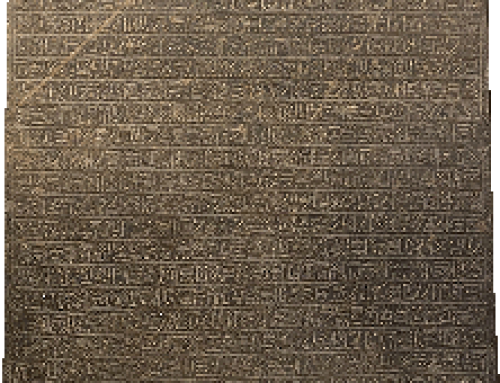
Many ancient stele, such as the Merneptah Stele and the Mesha Stele, are carved with inscriptions and images. The Rosetta Stone is unusual in that it bears three parallel inscriptions in three ancient languages: Egyptian hieroglyphics (top), Demotic (middle), and ancient Greek (bottom). Ancient Greek was well known by scholars at the time the stone was discovered. Demotic was an Egyptian script used for common purposes. It was familiar to scholars but still largely unknown. Considered sacred by the Egyptians, the knowledge of hieroglyphics had been lost since about the 4th century AD.
Because the same decree was inscribed in all three languages, scholars were eventually able to use the Greek to decipher the Demotic, and the Demotic to decipher the hieroglyphics. The breakthrough came in 1822 when French scholar Jean-François Champollion (1790-1832) recognized that the hieroglyphs recorded the sounds of the Egyptian language.
You may be surprised to learn that the Rosetta Stone is not unique. In fact, the decree–written on the stone in 196 BC–declares that similar stones be set up in all of the temples of Egypt. According to the British Museum, pieces of at least twenty-nine of these duplicates have been discovered across Egypt. But the Rosetta Stone was the first and it came into the hands of scholars at the right time. Because of the Rosetta Stone, the culture of ancient Egypt was unlocked. Egyptology grew into a disciplined science that in turn fostered the wider explorations of archaeology.
You can learn more about the Rosetta Stone at the British Museum.


Leave a Reply